Published by Shekie Mutumba · Editorial & corrections policy · Health information disclaimer
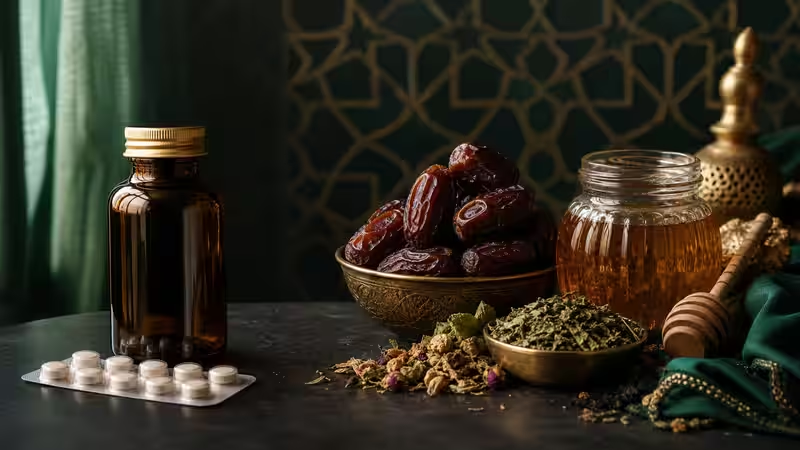
The most dangerous sentence a healer can say is “stop your medicine.” I will never say it, because the Prophet ﷺ commanded treatment, and because the Shāfī who answers my recitation is the same One who placed the cure in the pharmacy.
Every week someone sits across from me with a question loaded like a trap: “Sheikh, if I trust Allah, do I still need these tablets?” Sometimes the question is honest seeking. Sometimes it arrives already answered by a voice on a loudspeaker or a video that told them faith and medicine are rivals. My answer never changes, and this article is that answer written down: keep your medicine. Keep your doctor. Keep your scans and your injections and your physiotherapy. And keep your ruqyah beside them, because the two were never enemies except in the mouths of people who sell certainty they do not own.
The Prophet ﷺ commanded treatment
The texts are not subtle. The Messenger of Allah ﷺ said: “Allah has not sent down a disease except that He has sent down its cure; some people know it and some people do not” (Aḥmad, Ibn Mājah, al-Ḥākim; graded sound). And: “Make use of medical treatment, for Allah has not made a disease without appointing a remedy for it, except one disease — old age” (Abū Dāwūd, at-Tirmidhī). And in Muslim’s narration: “For every disease there is a cure; when the remedy meets the disease, healing occurs by the permission of Allah.”
These are not permissions to be declined politely; they are commands from the one who also recited over himself and was cupped. He lived both halves in one body: the recitation and the remedy, the du‘ā and the doctor. To take one half and call it the whole Sunnah is to follow the Prophet ﷺ selectively.
He used medicine, and he sent doctors
The sīrah is full of the practical half. The Prophet ﷺ took honey for the stomach, ordered cupping for the body, permitted the companions to treat a bitten chief with their medicine, and — in the narration of the physician sent to Ubayy ibn Ka‘b and the account of the doctor who came to Madīnah and reported that the people’s complaint required diet — engaged with the medicine of his day without contempt. The Companions consulted physicians; ‘Umar (may Allah be pleased with him) is reported to have organised treatment for the sick. Nobody in that generation understood trust in Allah as a refusal of means. The man who left his camel untied saying “I trust in Allah” was answered with the sentence that governs this whole matter: “Tie it, and trust in Allah” (at-Tirmidhī, Ibn Ḥibbān).
Tawakkul is not the abandonment of means
Here is the theological heart of it. Tawakkul — reliance on Allah — is a posture of the heart toward the One who controls outcomes; it is not a refusal of the doors He opened. The farmer trusts Allah and ploughs. The traveller trusts Allah and checks the brakes. The believer trusts Allah and swallows the tablet the physician prescribed, knowing the tablet heals nothing by itself and that the Physician of every healing prescribed it as a means. Refusing the means does not raise your trust; it turns trust into a test of Allah, and testing Allah is the opposite of relying on Him.
And consider what the decree actually contains. If Allah wrote your healing through the tablet, then refusing the tablet is refusing the door He wrote — not escaping the decree but colliding with it. The Salaf put it plainly: the cure is part of the qadar, and the means are part of the qadar, and the wise servant walks through the doors his Lord installed.
The fiqh of the body: preserving life is worship
The scholars derived from “And do not throw yourselves with your own hands into destruction” (al-Baqarah 2:195) and “And do not kill yourselves” (an-Nisā’ 4:29) a rule without exception in ordinary cases: the preservation of life and health is among the highest aims of the Sacred Law, and harming oneself without right is forbidden. The Prophet ﷺ said: “There should be neither harming nor reciprocating harm” (Ibn Mājah, Mālik) — and that includes the harm a diabetic does to his own kidneys by abandoning insulin in the name of a louder faith.
This is why I ask every patient three questions before any session: what has the doctor said, what are you taking, and when was your last test. Not to compete with the clinic, but to stand beside it — because a healer who does not know your medicines is a healer working blind, and blindness in a healer is negligence wearing a turban.
What I have seen when tablets are stopped
I will speak from what my own eyes have carried, because this is not theory. I have met the hypertensive man who stopped his medication after a sermon and met me again at his daughter’s wedding with one side of his face unmoving. I have met the young woman with epilepsy whose family hid her drugs in the name of ruqyah until a seizure took her from a staircase. I have sat with the diabetic grandmother who arrived with wounds the clinic could no longer save. In every case the voice that told them to stop was confident, and in every case the confidence belonged to a person who would not sit at the funeral. Faith that costs a kidney is not the faith of the Prophet ﷺ, who ordered treatment and paid the cupper and took the honey.
And the same rule covers the illnesses nobody photographs: depression, anxiety, psychosis. Medication and therapy for the mind are treatment like any other, ordained by the same command. The stigma that keeps a believer from his psychiatrist is not piety; it is fear wearing piety’s clothes. The heart and the brain are organs of the body the Shāfī made, and they are treated as organs are treated.
How ruqyah and medicine stand together
Picture two doors in one wall. Through one walks the physician with his science; through the other walks the reciter with his sūrah. Both doors open into the same room — the room of Allah’s permission — and neither door has a key of its own. The recitation comforts the soul, steadies the heart, and by Allah’s leave lifts harms the laboratory cannot name; the medicine steadies the body, corrects the chemistry, and by Allah’s leave repairs what the scan can see. A believer who walks through both has taken the whole Sunnah. A believer who stands between them, choosing, has invented a rivalry the religion never taught.
The middle path in practice: a checklist for my patients
So that this is not only words, here is the checklist I give every person who sits before me, and I give it in writing so no voice can later paraphrase me into something I never said.
- Never stop a prescribed medicine on anyone’s word but your prescriber’s. Not mine, not a video’s, not a dream’s. Doses are changed by the one who set them, with the tests that justify the change.
- Bring your medicines to every session. Names, doses, and the date of your last review. A healer who knows your tablets protects you twice.
- Tell your doctor about everything you take — the seed, the oil, the honey in medicinal amounts, the costus — because blessed foods still interact with chemistry, and your doctor cannot guard against what he does not know.
- Recite daily, whatever the clinic says. The adhkar are not a course with an end date; they are the breathing of a believer.
- Watch for the red signs — chest pain, breathlessness, fainting, fever that will not break, bleeding, a wound that blackens — and treat them as emergencies first and questions second.
- Measure your progress honestly. If you feel better, ask whether the tablet, the recitation, the rest, or all three carried you — and thank Allah for whichever door it was, because every door is His.
Follow these six lines and no preacher of false certainty can ever corner you again: you will be a patient who obeys his physician, a believer who obeys his Prophet ﷺ, and a servant who knows that both obediences lead to the same Lord.
So keep your medicine — and keep everything else
Keep your tablets and your appointments. Keep your al-Fātiḥah at dawn and your Āyat al-Kursī at night. Keep your seven ajwa dates and your spoon of honey and your olive oil. Keep your doctor’s number and your mother’s du‘ā. And when a voice — mine or any other — tells you that trusting Allah requires you to empty your medicine cabinet, answer it with the sentence that ends every such argument: the Prophet ﷺ commanded treatment, and the One who heals is the One who prescribed both doors.
If you remember nothing else from this page, remember the camel: tie it, and trust. Swallow the tablet and recite the sūrah; book the scan and keep the adhkar; honour the physician and honour the Prophet ﷺ who sent you to him. That is the whole of the balance, and it fits in one sentence, and it has saved more lives in my practice than any secret ever could.
Allāhumma innī a‘ūdhu bika min al-hammi wal-ḥazan, wal-‘ajzi wal-kasal — O Allah, I seek refuge in You from worry and grief, from weakness and laziness — and I take the means You placed in my hand while my heart rests in Yours.