Published by Shekie Mutumba · Editorial & corrections policy · Health information disclaimer
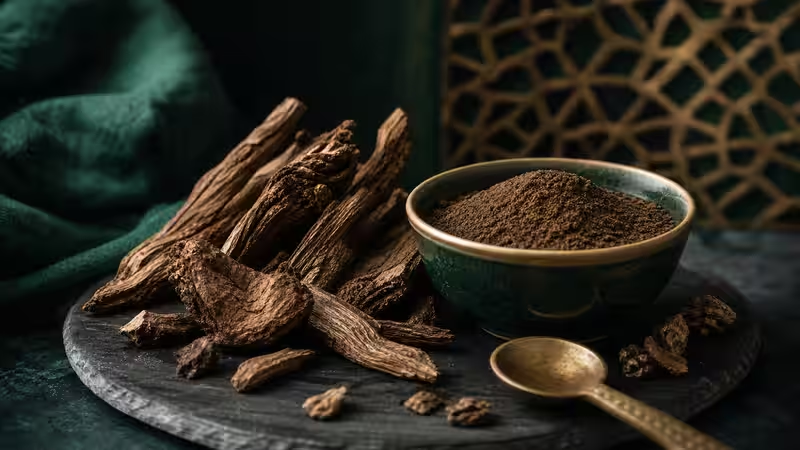
A bitter root from the hills, named by the Prophet ﷺ among the remedies of his ummah. Used in pinches with knowledge, it is sunnah; used in fistfuls with fear, it is only a bitter powder.
In the old souqs it is sold as dark shards and a darker powder, bitter to the tongue and strong in the nose: qust al-hindī, the Indian costus. It is among the few remedies the Prophet ﷺ named by origin — the Indian — and among the few whose hadith counts its cures: seven. Like every named remedy it suffers both neglect and exaggeration. Here is its text, its tradition, its honest science and its manners.
The hadith of the seven cures
Umm Qays bint Miḥan reported the Messenger of Allah saying: “Use the Indian costus, for in it are seven cures; it is a remedy for seven diseases, among them dhuṭ al-janb (pleurisy)” — in the wording of al-Bukhārī and Muslim: “…and it is a cure for pleurisy”, with the instruction to sniff it or administer it in the nose in one narration and to drink it in another. In Muslim’s fuller account: “Indeed in this Indian costus there is surely healing: from it are seven cures, among them pleurisy; it is sniffed for the head and drunk for the inner (complaint).”
Three notes on the text. The number seven here is the Prophet’s ﷺ own enumeration and the scholars received it as a statement of breadth — a remedy of many doors — without pretending to fix a laboratory list. The named door, pleurisy (the stabbing pain of the side and chest), is the one the hadith guarantees by name. And the methods are two and physical: sniffed or instilled for the head, drunk for the inward complaint — a medicine administered like a medicine, by a ummah that never confused remedy with ritual object.
The tradition: how the Muslims took it
The classical physicians carried the hadith into practice. Ibn Sīnā and the writers of the medical tradition describe the costus — white and Indian varieties — as warming, drying, opening obstructions, useful for the chest, the side, the cold complaints of the stomach and the heaviness of the head. The folk practice of the Muslim world kept three doors: a pinch of the powder in warm water or honey, taken once or twice daily; a sniff or few drops of its infusion for the blocked head and the heaviness of the sinuses, following the hadith’s nasal door; and a rub of costus-infused oil on the side and chest for the pain of pleurisy and the cold ache of the ribs.
My own practice keeps precisely these three, in small measures, and adds the rule I apply to every strong remedy: begin low, watch the body, and stop at the first sign it objects — for the body is a witness the Sunnah teaches us to listen to.
What the research honestly shows
The laboratory has looked, and the findings are interesting without being triumphant. Costus (Saussurea costus / Saussurea lappa) shows antimicrobial, anti-inflammatory and antioxidant activity in vitro; animal work reports effects on inflammation and on some pathogens; its traditional use for respiratory complaints is the subject of ongoing phytochemical interest. Human clinical trials of the quality that would confirm “seven cures” do not exist. The honest statement is therefore: a traditional remedy with a Prophetic text and preliminary laboratory support, whose named cure (pleurisy) belongs today to the clinic’s antibiotics and care — and whose place in a Muslim home is as sunnah and support, never as a substitute for the treatment of a chest infection, which can kill.
That last clause is not caution for caution’s sake. Pleurisy and pneumonia present alike in their early hours; a believer who sniffs powder while his lungs consolidate has misunderstood the hadith that named the cure and ignored the Prophet ﷺ who commanded treatment.
How to take it, in measures
- The drink. A pinch to a quarter-teaspoon of fine powder, stirred into warm water or a spoon of honey, once daily to begin; the taste is bitter and the stomach’s opinion should be consulted before the second week.
- The head. Following the nasal door of the hadith: a drop or two of a weak, cooled infusion sniffed gently, or the powder kept at a distance and inhaled in trace — never forced, never in children, never into an inflamed or bleeding nose.
- The side. Costus warmed gently into olive or black-seed oil, massaged over the ribs and chest for the cold ache — outside the body, where the risk is least and the comfort real.
- The measure. Small and short: a week or two, then a pause. Strong remedies are guests, not residents.
Cautions the powder-sellers omit
- Pregnancy: avoid. The costus has a traditional reputation for moving the womb; no pregnant woman takes it in any medicinal measure.
- The stomach: respect it. Its bitterness and warmth can aggravate reflux and gastritis; the ulcerated stomach gives it no welcome.
- Allergy and asthma: test in trace. A fine powder inhaled by an asthmatic airway can provoke what it was meant to relieve; the sniffing door belongs to the healthy sinus, and the asthmatic asks his physician first.
- Adulteration and substitution. Much “qust” in the markets is other roots ground dark; buy whole shards you can see and smell, from a source you can name, and grind at home.
- Children: not without a clinician. The hadith’s measures are for adults; a child’s airway and stomach are not small adults’.
The root in the house of the Salaf and the markets of the ummah
The costus travelled the ummah’s roads with the hadith that named it: from the ports of India and the Yemen to the souqs of Madīnah, Kufa and Cairo, carried by the same caravans that carried pepper and cloth, and sold beside them as a remedy rather than a spice. The classical writers distinguish the Indian and the sea-costus and prefer the Indian, warm and bitter; the households kept it in whole shards against the weevil and the damp, grinding a week’s powder at a time as my own practice does. It appears in the physicians’ chapters of the chest and the side, and in the folk notebooks of every land from Morocco to Malaya — a quiet testimony that the ummah received the hadith not as a curiosity but as a prescription, and kept it alive in kitchens for thirteen centuries.
Combining it with the rest of the pantry
The costus is rarely taken alone in the tradition; it rides with the pantry’s other blessings. A pinch in the morning honey, beside the black seed’s half-teaspoon, is the commonest pairing in the folk practice — two named remedies in one spoon, each in its measure. In winter the powder warms into the talbinah’s bowl for the chest that aches with the cold; in the rubbed oil it joins olive and nigella for the side and the ribs. The rule that governs all such combining is the rule of measures: each remedy keeps its pinch, and no bowl becomes a pharmacy of twelve powders, for the Sunnah’s medicine is a pantry of simple doors opened one at a time — not a cauldron of everything at once, which is the folk-magic’s habit and not the Prophet’s ﷺ.
Why “seven” matters more than the powder
There is a lesson inside the number. The Prophet ﷺ named seven cures in a root a trader sells by the handful — and the ummah’s scholars received it as a teaching about means: that Allah places many doors in small things, and that the believer’s medicine is a pantry of opened doors rather than a single locked miracle. The same habit of mind keeps a Muslim from idolising any remedy, costus included: seven cures is a praise of the Creator’s generosity in one root, not a contract the root signs. Take the pinch with gratitude, keep the clinic’s door open beside it, and return the thanks to the One who put seven doors in a bitter shard.
The root in the house
Keep a small jar of whole shards in the cupboard, grind a week’s powder at a time, and label it with its name and its manners — pinch, not fistful; warm water, not fear. Offer it to the adult who asks, with its cautions spoken plainly; refuse it gently to the pregnant, the ulcerated, the asthmatic and the child, and send each to the door that suits them. And when the chest pains come — the real ones, with fever and breathlessness — close the jar and open the road to the hospital, for the Prophet ﷺ who praised the costus also said: “Make use of medical treatment.”
That is the whole of the balance: a bitter root honoured in pinches, a clinic honoured in emergencies, and a Lord honoured in both — the One who put seven cures in a shard and a thousand in His mercy. Keep the jar, keep the measures, and keep the physician’s number beside the jar; and let every pinch you take be a small obedience, remembered with the tongue that named it blessed thirteen centuries ago.
Allāhumma ‘āfinī fī badanī, allāhumma ‘āfinī fī sam‘ī, allāhumma ‘āfinī fī baṣarī — O Allah, grant me wellbeing in my body, in my hearing, in my sight.