Published by Shekie Mutumba · Editorial & corrections policy · Health information disclaimer
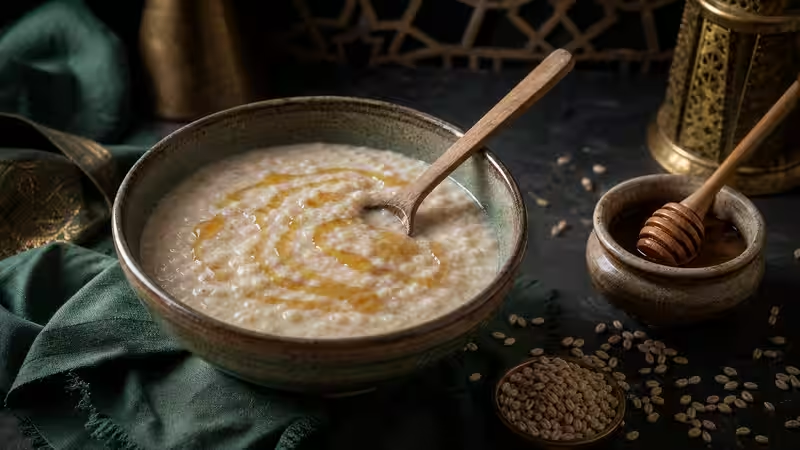
“It strengthens the heart of the sorrowful and relieves some of the sadness of the sick.” A bowl of barley, milk and honey — the tenderest prescription in the Sunnah, and the one most forgotten.
Among the foods of the Prophetic medicine there is one prescribed not for an organ but for a feeling. When a household grieved, when a body was too weak to hold ordinary food, the Messenger of Allah ﷺ did not send a sermon or a strong medicine; he sent a pot of barley broth. Talbinah is the most tender item in the whole pantry of Tibb an-Nabawi, and the most neglected. This article restores it: its hadith, its cooking, its science and its place in a grieving house.
The hadith of the sorrowful heart
‘Ā’ishah (may Allah be pleased with her) reported: “When a member of the Prophet’s ﷺ household fell ill, she would cook talbinah and order it to be given to them, saying: it is from the words of the Messenger of Allah ﷺ — ‘the talbinah strengthens the heart of the sorrowful and relieves some of the sadness of the sick’” (al-Bukhārī and Muslim). In another narration she called it “the talbinah of the bereaved”, and she would order it made for the woman afflicted by a death in her family.
Read the wording with care, because its tenderness is its science. The broth strengthens the heart — the qalb, the seat of grief in the Qur’anic anatomy — of the sorrowful, and relieves some of the sadness of the sick. Not “cures,” not “removes”: strengthens and relieves. The Prophet ﷺ prescribed comfort where cure was not the point, and in doing so taught every healer after him that nourishment and consolation are one act.
What talbinah actually is
The name comes from laban, milk, for its whiteness and softness. It is a thin porridge or broth made from barley — whole barley flour or crushed barley — cooked slowly in water or milk until smooth, then sweetened with honey. Ibn al-Qayyim described it in the Prophetic Medicine as the broth of barley flour, cooked well, skimmed, and given warm; and he noted what any cook knows: it is gentle on the stomach, slow to spoil in the digestion, and kind to the weakened.
Barley (sha‘īr) is among the oldest grains of the Muslim lands and among the humblest: the bread of the Prophet’s ﷺ household when there was wheat in the market and they chose otherwise, the grain of the poor across every century of Islam. That the Sunnah’s comfort food is the poor man’s grain is not an accident; it is the religion’s economics made edible.
How to cook it properly
- The grain. Two tablespoons of barley flour, or a handful of pearl barley soaked and blended; the flour gives the smoother, whiter talbinah of the descriptions.
- The liquid. Two cups of water for the sick stomach, or milk for nourishment; milk talbinah is the richer, water talbinah the gentler.
- The fire. Low, and slow, with stirring — the broth must never boil hard, for fierce heat ruins its silk and, the cooks say, its kindness.
- The sweetening. Off the heat, a spoon of honey stirred in warm — never boiling — liquid, honouring both the hadith of honey and the etiquette of not destroying it.
- The serving. Warm, in a deep bowl, with a word of du‘ā over it; for the bereaved, eaten slowly and in company, never alone in a dark room.
Ten minutes of stirring, and a house has obeyed a hadith with a wooden spoon.
Why it suits the weak and the grieving
The classical physicians prized barley broth for the fevered and the convalescent: easy to swallow, easy to digest, moistening, and slow to burden a stomach that illness has shrunk. Modern nutrition agrees in its own language: barley’s beta-glucan fibre is gentle and soluble, its release of energy slow, its warmth and liquid volume exactly what a dehydrated or grieving body needs — for grief, as every mourner knows, closes the throat and empties the appetite, and a bowl that asks little and gives much is the only meal such a house will accept.
And there is a second layer the texts gesture at: the ritual of it. Someone must stand at the fire for the grieving; someone must carry the bowl; someone must sit while it is eaten. Talbinah is therefore not only food but a choreography of care — the Sunnah’s way of ensuring that no sorrow in a Muslim house goes unwitnessed, and that love arrives in the only form grief can digest: warm, soft, and shared.
Talbinah and the mind: honesty about the limits
Sincerity requires the boundary drawn. Talbinah comforts; it does not treat clinical depression, and no bowl of barley replaces the physician and the therapist where the mind is ill. The grief the hadith addresses is the sorrow of the bereaved and the sadness of the sick — real, heavy, and ordinary — and for that the broth, the company and the du‘ā are precisely the prescription. Where sadness deepens into an illness that steals sleep, appetite and hope for weeks, the Sunnah’s own command applies: seek treatment — and take the talbinah along to the appointment, because the two were never rivals.
The diabetic, too, keeps the honey within his allowance; the coeliac knows barley is gluten; the infant is not given honey. The blessed foods carry their cautions like every mercy carries its manners.
Variations the classical kitchen knew
The base broth is barley and liquid and honey, but the tradition’s kitchen knew gentle variations for different bodies, and they are worth keeping. For the fevered and the very weak, the thinnest talbinah — barley flour in water only, long-cooked and skimmed — given in sips through the day rather than a bowl at a meal. For the convalescent regaining strength, the milk talbinah, richer and slower, with the honey stirred in off the heat. For the grieving with no appetite at all, the broth sweetened with dates instead of honey, their sweetness milder and their barakah named. And for the cold season, a whisper of cinnamon warmed in the pot — a later kitchen’s addition, harmless and comforting, kept outside the claim of sunnah and inside the claim of kindness. What the tradition never varied is the manner: low fire, patient stirring, served warm, and carried to the sorrowful by a hand that stays.
The etiquette of carrying the bowl
Because talbinah is prescribed for grief, its delivery carries an etiquette of its own. Come with the bowl and stay for its eating; the bereaved who must insist you leave will not eat, and the Sunnah’s medicine is company as much as barley. Do not announce the hadith like a lecture at the doorway; say it softly, once, over the pot or over the bowl — it strengthens the heart of the sorrowful — and let the words do their quiet work. Do not send talbinah to a grieving house by a child or a driver if you can carry it yourself, for what the mourner receives is not only food but the evidence that he is remembered. And when your own house grieves, accept the bowls that arrive and eat a little of each: refusing comfort is not strength, and the Salaf received the comfort of their brothers as part of the decree’s mercy.
Keeping it in the house
Three habits restore this sunnah to a household. Keep barley flour in the cupboard beside the honey, so that the night someone falls ill or receives bad news, the pot can be on the fire within minutes — for the sunnah of comfort delayed is comfort missed. Teach the daughters and sons to make it, naming the hadith as they stir, so that the recipe carries its evidence inside it. And when a neighbour grieves, do not send only messages: send a covered bowl. The Salaf understood that a condolence you can eat is worth a hundred condolences you can only read.
A bowl, and a theology
Talbinah teaches, in the end, what the whole of Tibb an-Nabawi teaches: that Allah placed healing in the humblest of things — a grain the poor man buys, a spoon of honey, a low fire — and that He made the healing of hearts partly physical, because He created hearts in bodies. The Prophet ﷺ who recited over the sick also ordered the broth; who commanded patience also commanded nourishment; who taught that the believer’s matter is with Allah also knew that a sorrowful heart eats badly and must be fed anyway.
So when grief next enters your door, do what ‘Ā’ishah did: put the barley on the fire, stir it slowly, sweeten it off the heat, carry it to the sorrowful, and say the words that make a meal into a medicine — it strengthens the heart of the sorrowful — and let the Lord of hearts do with the heart what He wills.
So put the barley on the fire tonight if any heart in your house is heavy, and say the du‘ā over the bowl as you carry it: Allāhumma ajurnī fī muṣībatī wakhluf lī khayran minhā — O Allah, reward me in my affliction and replace it for me with better than it.