Published by Shekie Mutumba · Editorial & corrections policy · Health information disclaimer
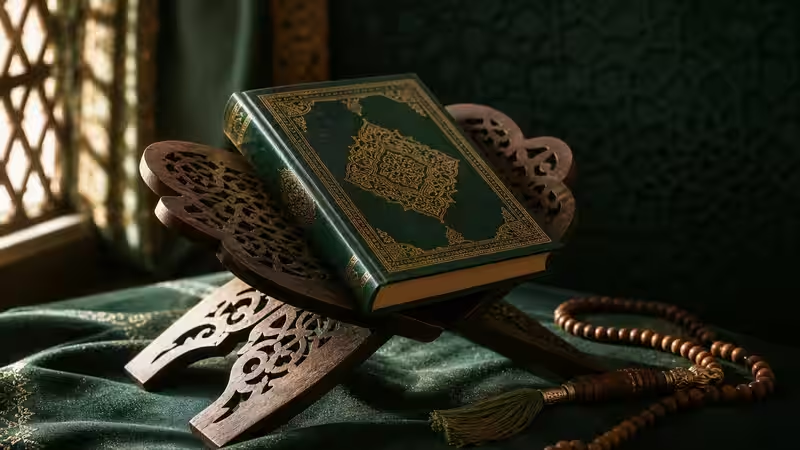
Ruqyah is neither magic nor medicine, neither a show nor a guarantee. It is worship: reciting the Book of Allah and the supplications of His Messenger ﷺ over a person, with the heart certain that the cure belongs to Allah alone.
People come to me for two opposite reasons. Some arrive afraid, convinced that anyone who blows over a sick person must be touching something dark. Others arrive expecting a miracle on demand, ready to pay whatever I name for a result they believe I can promise. Both groups have misunderstood the same thing. So before anything else on this site, this article states plainly what ruqyah is — and, just as importantly, what it is not.
The word and what it means
Ruqyah (رقية), in its simplest form, is the recitation of verses of the Qur’an, and of supplications authentically reported from the Prophet Muhammad ﷺ, over a person who is unwell, distressed, or seeking protection — with the intention of seeking healing and safeguarding from Allah. The scholars call the permissible form ruqyah ash-shar’iyyah, the ruqyah according to the Sacred Law, to distinguish it from the ruqyah of the pre-Islamic sorcerers, which was built on invocations of jinn, obscure symbols and words whose meaning no one could explain.
Nothing in that definition is mysterious. There is no secret technique, no hidden science, no licence that separates the reciter from the ordinary believer. A mother reciting over her child, a husband reciting over his wife, a man reciting over himself in his room at night — all of this is ruqyah, and all of it is open to every Muslim who can read.
The evidence that it is legislated
Allah describes His Book as healing: “And We send down of the Qur’an that which is healing and mercy for the believers” (al-Isrā’ 17:82), and He quotes the disbelievers wondering, “Is it not enough for them that We have sent down to you the Book which is recited to them? Indeed in it is a mercy and reminder”, while the believers answer with the Prophet’s ﷺ own practice of seeking cure in it.
The Prophet ﷺ himself was recited over. When he fell ill, ‘Ā’ishah (may Allah be pleased with her) reported that he would recite Sūrat al-Ikhlāṣ, al-Falaq and an-Nās over himself, blow into his hands, and wipe them over his body (al-Bukhārī and Muslim). And when he suffered, Jibrīl performed ruqyah over him with the words: “In the name of Allah I perform ruqyah over you, from everything that harms you, from the evil of every soul or envious eye, may Allah cure you, in the name of Allah I perform ruqyah over you” (Muslim).
The Companions practised it too. In the well-known account, a group of Companions passed by a tribe whose chief had been stung by a scorpion. One of them recited Sūrat al-Fātiḥah over him, and the man stood up as though released from a chain. They asked the Prophet ﷺ about the reward they had accepted, and he said: “You did right — and allocate a share for me” (al-Bukhārī and Muslim). From this the jurists derived that ruqyah is permissible, that accepting a modest gift for it is not forbidden, and that al-Fātiḥah in particular is a ruqyah.
The Prophet ﷺ also set the boundary in one sentence: “There is no harm in ruqyah as long as it does not involve shirk” (Muslim). That single condition is the whole of the science.
The three conditions the scholars set
From these texts the scholars of Islam distilled three conditions for a ruqyah to be lawful.
- It must be with the speech of Allah, His names and attributes, or the words of His Messenger ﷺ. Recitation, dhikr and authentic du‘ā — not invented incantations, not names of jinn, not grids and sigils.
- It must be in Arabic, or in words whose meaning is clearly understood. Obscurity is the doorway of shirk; if neither the reciter nor the patient knows what is being said, neither can testify that it is good.
- The heart must hold that the ruqyah itself has no power. It is a means, and the cure is from Allah alone. The reciter is a supplicant, not a healer; the words are a rope, not a hand.
Everything else — blowing lightly, wiping, using water or oil that has been recited over — is detail within these three conditions, practised by the Salaf and permitted by the jurists so long as no belief of independent power is attached to it.
What ruqyah is not
Here is where most harm is done, and it is done in both directions: by those who fear ruqyah and by those who sell it.
It is not magic, and it has nothing to do with magic
Magic (siḥr) seeks the cooperation of jinn through what displeases Allah; ruqyah seeks the favour of Allah through what He loves. The two stand on opposite sides of the same door. A reciter who whispers to jinn, who asks them for news, who ties knots or writes talismans of unknown meaning, has left ruqyah and entered the territory the Qur’an condemns. The moment a session involves secrets, symbols, or a demand for the patient’s mother’s name, it is no longer ruqyah.
It is not a replacement for medicine
The Prophet ﷺ said: “Allah has not sent down a disease except that He has sent down its cure” (al-Bukhārī), and he instructed the believers to seek treatment. Ruqyah runs alongside the clinic, never instead of it. Anyone who tells you to stop your tablets, cancel your scan, or skip your injection in favour of recitation has contradicted the Sunnah he claims to follow. I tell every person who sits before me: keep your doctor, keep your medicine, and let the recitation be the companion of your treatment, not its rival.
It is not a guarantee of an instant result
Allah heals whom He wills, when He wills, and sometimes He withholds the cure for a wisdom we will only meet in the Hereafter. A sincere ruqyah that appears to change nothing outwardly has not failed; it has been worship, and worship is never wasted. Anyone who promises you a result by a certain date is selling you something that belongs to Allah alone.
It is not a performance and not a business
There is no theatre in the Sunnah’s ruqyah: no dramatic collapses demanded, no crowds gathered for spectacle, no prices scaled to the patient’s desperation. A quiet room, a sincere reciter, a patient heart — that is the entire scene. Modest gifts are lawful as the hadith of al-Fātiḥah shows, but a reciter who measures his recitation by the fee has inverted the worship.
It is not a diagnostic machine
Ruqyah does not tell you which organ is diseased, which relative envied you, or which neighbour cast the eye. Claims of hidden knowledge — “your aunt did this to you in 2019” — are guesses dressed as revelation, and acting on them destroys families on the strength of a rumour. The ruqyah addresses the harm; it does not put people on trial.
It is not reserved for the “possessed”
The ordinary believer recites over himself every morning and evening. The mu‘awwidhatayn, Āyat al-Kursī, the du‘ās of the morning and evening — these are ruqyah in daily clothing. You do not need a specialist to be protected; you need consistency.
How a sincere session looks
So that no one is deceived, here is what honesty looks like in practice: the reciter begins in wuḍū’, recites aloud or softly from the Qur’an — al-Fātiḥah, Āyat al-Kursī, the closing verses of al-Baqarah, al-Ikhlāṣ, al-Falaq, an-Nās — repeats what the Sunnah repeats, blows lightly without spittle, makes du‘ā for the patient by name, and reminds the patient of tawbah, prayer, and the morning and evening adhkar. There is no secrecy, no demand for objects of the patient’s body, no forbidden isolation between unrelated men and women, and no promise beyond “we ask Allah, and He gives what He wills.”
Ruqyah in the home: water, oil and the daily adhkar
Two practices sit at the edge of the definition and deserve a word. Reciting over water or over oil — olive oil, black-seed oil — and then drinking or anointing with it, is reported from the Salaf and permitted by the jurists, on the understanding that the barakah sought is in the recitation and the One who answers it, never in the liquid itself; the water is a carrier of du‘ā, not a charm. The second is the ruqyah you never book: the morning and evening adhkar. Āyat al-Kursī at night, the three quls three times at dawn and dusk, the du‘ās of entering and leaving the home — this is ruqyah worn daily, and it protects more households than any session ever will.
What you should walk away with
Ruqyah is worship wearing the clothing of healing. Take it with reverence, not fear; with hope, not demand. Recite over yourself before you seek anyone else, guard your mornings and evenings, keep your medicine, and hold your heart certain that the One who sent the disease sent the cure — and that the cure arrives by His decree, through whichever door He chooses, recitation and clinic alike being doors He opens.
Allāhumma Rabban-nās, adhibil-ba’sa washfi, antash-Shāfī, lā shifā’a illā shifā’uka, shifā’an lā yughādiru saqaman — O Allah, Lord of mankind, remove the harm and heal, for You are the Healer; there is no cure except Your cure, a cure that leaves no illness behind.