Published by Shekie Mutumba · Editorial & corrections policy · Health information disclaimer
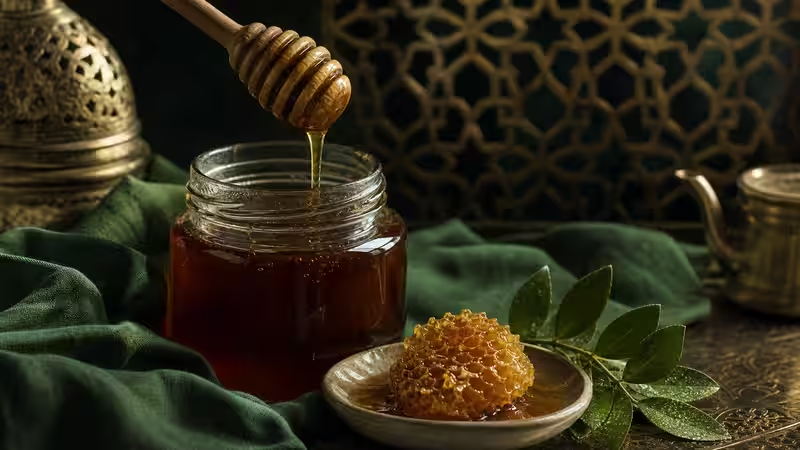
“There emerges from their bellies a drink of varying colours, in which is healing for people.” The Qur’an named honey a medicine before any laboratory did. Here is the sidr honey of the markets, with its evidence and its adab.
Of all the foods of the Prophetic medicine, honey holds the strangest honour: it is the only one praised in the Qur’an in the language of medicine. Not as a delight, not as a provision — as a healing. And among honeys, the sidr — drawn from the lote tree of the mountains of Yemen and Hadramawt — carries the oldest reputation in the Muslim world. This article gathers the texts, the uses, the honest science and the market’s deceptions, so that a believer can keep honey in his house as the Sunnah keeps it: as food, as medicine and as a mercy.
The verse that named it healing
Allah says of the bee: “And your Lord inspired to the bee: take from the mountains dwellings, and from the trees and from what they construct. Then eat from all the fruits and follow the ways of your Lord laid down for you. There emerges from their bellies a drink of varying colours, in which is healing for people. Indeed in that is a sign for a people who give thought” (an-Naḥl 16:68–69). Read the verse slowly: the healing is stated as a fact of the drink, and the sign is offered to those who think. The classical commentators noted that the verse says shifā’ — healing — without restriction, while the hadith specify and the physicians apply.
The hadith of the stomach
The most famous application is the account in al-Bukhārī and Muslim: a man came to the Prophet ﷺ complaining of his brother’s diarrhoea. The Prophet ﷺ said: “Give him honey.” The man returned: “I gave him honey and it only increased him.” The Prophet ﷺ said again: “Give him honey” — and on the third or fourth return he said the sentence the physicians of Islam have quoted for fourteen centuries: “Allah has spoken truth, and your brother’s belly has lied.” The man gave it, and his brother was healed. Two lessons live in it: the Prophet ﷺ prescribed honey as medicine, repeatedly, in the face of an apparent worsening; and the cure arrived by Allah’s permission through the means he named — not around it.
And the general hadith: “Healing is in three: a drink of honey, the incision of the cupping vessel, and branding with fire — and I forbid my ummah from branding” (al-Bukhārī). Honey stands first among the three.
Why sidr? The tree the Qur’an mentions
The sidr (lote) tree appears in the Qur’an twice in honour: sidrat al-muntahā, the lote tree of the utmost boundary, at which the Prophet ﷺ stood in his ascent (an-Najm 53:14), and the gardens of sidr of the people of Saba’ (Saba’ 34:16). The tree is thorny, deep-rooted, drought-hardy; its blossom is brief and its nectar concentrated, which is why sidr honey is dense, dark-golden, slow to crystallise, and bitter-sweet at the back of the throat. The honeys of Hadramawt and of the Yemeni highlands have carried the name for centuries, and Kashmir’s sidr stands beside them. Where the tree is honoured, the honey is honest; where the name is famous, the counterfeit follows — which is the market’s problem, not the tree’s.
How to use it at home, as the Sunnah uses it
- The morning spoon. A teaspoon on an empty stomach, or stirred into water that is warm — never boiling, for fierce heat damages what the verse praised.
- The throat and the cough. Honey taken slowly, coating the throat, is the oldest cough remedy in the Muslim house and among the few with modern support.
- The stomach. As in the hadith: honey in warm water, repeated, for the loose stomach — and with the physician consulted where blood, fever or persistence appear.
- The wound. The Salaf applied honey to wounds; today medical-grade sterilised honey is used in clinics for burns and ulcers. At home, honey belongs on minor, clean, superficial wounds after washing — never on deep, dirty or surgical ones, and never instead of a doctor where infection signs appear.
- Recited over. Honey recited over with al-Fātiḥah and the quls, then eaten or anointed, is the practice of the Salaf: the barakah sought is in the recitation and its Author, the honey an honoured carrier.
What the research honestly shows
Here sincerity requires precision. Honey’s antibacterial activity — its osmotic pull, its acidity, its hydrogen peroxide — is well documented in the laboratory, and medical-grade honey (including studies on sidr and manuka types) has genuine evidence in wound and burn care, and modest evidence for cough and sore throat. Claims beyond that — honey curing cancer, diabetes, infertility — outrun the evidence and must not be preached. The verse says healing; it does not say every healing, and the Prophet ﷺ who praised honey also sent for physicians. Keep the science in its lane and the blessing in its own: both are true, and neither needs the other exaggerated.
Cautions the honey-sellers omit
- Infants under one year: none. Honey can carry botulism spores that an infant’s gut cannot resist. This rule admits no exception and no “just a taste.”
- Diabetes: measure it. Honey is sugar with virtues; it raises glucose. The diabetic takes it inside his allowance, with his doctor’s knowledge, or not at all.
- Allergy: test it. A minority react to pollens in honey; begin small.
- Adulteration: the real danger. Much “sidr” on the world market is blended, heated or fed sugar syrup. Buy from a keeper you can name, in a jar with a harvest and a source, and distrust both the miracle price and the miracle markup.
Honey in the house: a sunnah kept simply
Keep one honest jar in the kitchen and one small recited jar in the medicine cupboard. Teach the children that the spoon of honey at breakfast is a verse of the Qur’an eaten slowly. Give a jar to the sick you visit — it is among the few gifts that are at once food, medicine and du‘ā. And when the cough comes at night, reach first for what the bee inspired by your Lord carries in its belly, before the chemistry of the shelf — and reach for the clinic as well, whenever the body asks for it, because the same Lord who inspired the bee sent the physician.
What the verse teaches about work
There is a second sign inside the verse of the bee, and it is for the worker rather than the patient: “follow the ways of your Lord laid down for you.” The bee is inspired to a route — out, gather, return, give — and it follows it without argument, and from that obedience emerges healing for people it will never meet. The Muslim who reads the verse over his breakfast spoon is being taught his own economics in miniature: do the work you were laid down to do, faithfully and without seeing the end of it, and Allah will bring healing out of your belly of labour for people you will never meet. Honey is, in this sense, the most honest product in the market — nothing in it but obedience, blossom and time.
Honey at suḥūr and ifṭār
Two moments in the Muslim year give honey its natural place. At suḥūr, a teaspoon in warm water or over talbīnah steadies the fasting body with slow sweetness, in the spirit of the Prophet’s ﷺ own breaking and beginning of days with simple, blessed food. At ifṭār, after the dates and the water, honey in milk or over barley bread returns strength without the crash of refined sugar — and in households with children, the ramadan jar teaches them that sweetness and blessing were never separate things. The diabetic keeps both moments inside his allowance with his doctor’s word; the rest of us keep them with gratitude, knowing that the verse which named honey a healing also named it a sign — and signs are read slowly, the way honey is eaten.
A drink of varying colours
The verse ends by pointing: “Indeed in that is a sign for a people who give thought.” The sign is not only in the chemistry but in the courtesy of it — that Allah placed healing in the belly of an insect, in colours that change with the blossom, in a jar a poor man can afford. Take your sidr honey, then, as the Salaf took it: a spoon in the morning, a smear on the wound, a recitation over the jar, and a heart that knows the Healer is not in the honey — but that the honey, like everything He made, is exactly where He put it.
Keep your jar honest and your spoon grateful, and let the verse stand over both: a drink of varying colours, in which is healing for people — and a sign, for those who give thought, that the Merciful places medicine in the smallest of His servants and asks only that we receive it with clean hands and a remembering heart.
Allāhumma bārik lanā fīhi wa zidnā minhu — O Allah, bless us in it and increase us from it.