Published by Shekie Mutumba · Editorial & corrections policy · Health information disclaimer
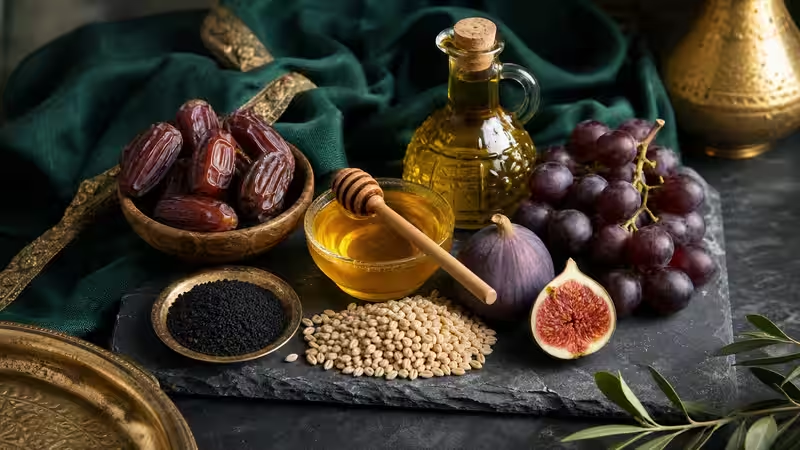
The Prophet ﷺ left a small pantry of blessed foods. Used with knowledge they are a mercy; used as magic they are a distortion. Here is each one with its evidence, its use and its warning.
The medicine of the Prophet ﷺ is not a pharmacy of rare imports. It is a handful of foods that grow in the markets of every Muslim land: a seed, a date, a spoon of honey, a measure of oil, a cup of water, a bowl of barley broth, a root from the hills. Each carries an authentic text; each carries, in the same breath, a lesson about how a believer relates to food, healing and trust in Allah. Here are seven of them, honestly gathered.
1. The black seed — ḥabbat al-barakah
The Prophet ﷺ said: “In the black seed there is healing for every disease except death” (al-Bukhārī and Muslim). In another narration it is called ḥabbat al-barakah, the seed of blessing. The seed is nigella sativa, small and matte-black, peppery when crushed. The tradition of using it runs through the generations: ground and mixed with honey, pressed into oil, or taken a few seeds at a time.
What the hadith gives us is a blessing and a direction, not a dosage chart. Modern study has examined nigella for inflammation, blood pressure and blood sugar with encouraging but preliminary results; nothing yet reaches the height of the hadith’s wording, and a believer does not need it to. Use it as food and sunnah: half a teaspoon of the seed or its cold-pressed oil with honey, daily, and caution in pregnancy with concentrated oil, and in anyone on medication that lowers sugar or pressure — mention it to your doctor.
2. Ajwa dates — the morning shield
The Prophet ﷺ said: “Whoever eats seven ajwa dates in the morning, neither magic nor poison will harm him that day” (al-Bukhārī and Muslim). The ajwa is a dark, soft date of Madīnah, and the hadith ties its protection to a specific number and a specific time — a detail the scholars read as an act of worship whose wisdom we accept rather than dissect.
In practice: seven in the morning, on an empty stomach where possible, chewed slowly. For the diabetic, dates remain a date: sugar is sugar, and the sunnah of preserving life asks you to count them within your day’s allowance and speak with your doctor. Protection in the hadith is from Allah; the date is its honoured vessel.
3. Honey — the drink of healing
Allah says of the bee: “There emerges from their bellies a drink of varying colours, in which is healing for people” (an-Naḥl 16:69), and the Prophet ﷺ said: “Healing is in three: a drink of honey, the incision of the cupping vessel, and branding with fire — and I forbid my ummah from branding” (al-Bukhārī). The famous account in al-Bukhārī and Muslim tells of a man whose brother suffered a stomach complaint; the Prophet ﷺ instructed honey, repeatedly, until the man was healed.
Honey is food, medicine and worship at one table: a spoonful in warm — never boiling — water, on wounds in the traditional practice, in the household of every believer. Two cautions stand firm: no honey for an infant under one year, whose gut cannot yet defend against botulism spores; and for the diabetic, honey is still sugar and must be weighed, not dismissed.
4. Olive oil — eat it and anoint with it
“Eat olive oil and anoint yourselves with it, for it comes from a blessed tree” (at-Tirmidhī, Ibn Mājah; the tree blessed in the Light Verse of Sūrat an-Nūr, 35). The olive is the oil of the Mediterranean and of the Qur’an: pressed, green-gold, bitter at the back of the throat in the good cold-pressed kind.
Use it as the hadith says, in both directions: on the table over vegetables and bread, replacing the seed oils of the factory; and on the skin and scalp, alone or recited over in ruqyah, as generations of Muslims have anointed themselves. It is among the few sunnah foods whose everyday benefit — in place of poorer fats — is supported by ordinary nutrition science as well as by revelation.
5. Zamzam — water that satisfies
The Prophet ﷺ said of the well of Makkah: “It is blessed; it is food that satisfies” (Muslim), and: “The water of Zamzam is for whatever it is drunk for” (Ibn Mājah; graded sound by a number of the muhaddithūn). Pilgrims drink it for healing, for provision, for a need of the heart — and the hadith teaches that the intention of the drinker is part of the drinking.
At home, zamzam is kept with respect: drunk seated where possible, with the du‘ā of the Salaf — Allāhumma innī as’aluka ‘ilman nāfi‘an wa rizqan wāsi‘an wa shifā’an min kulli dā’ — and never treated as a charm to be hoarded or sold at a magician’s price. It is water, and it is more than water, and both halves of that sentence must be held together.
6. Talbinah — broth for the grieving heart
When a member of the Prophet’s ﷺ household fell ill, he ordered talbinah to be made, saying: “It strengthens the heart of the sorrowful and relieves some of the sadness of the sick” (al-Bukhārī and Muslim). Talbinah is a thin porridge of barley flour, cooked with water or milk and sweetened with honey — humble, warm, easy on a weakened stomach.
It is the most tender of the seven: a food prescribed for grief. In a household with a sick or mourning member, a pot of talbinah is sunnah in a bowl. Barley is slow-release and gentle; for the diabetic it is among the kinder grains, though honey’s sweetness should be measured.
7. Qust al-hindī — the Indian costus
Umm Qays reported the Prophet ﷺ saying: “Use the Indian costus, for in it are seven cures; it is a remedy for seven diseases, among them dhuṭ al-janb (pleurisy)” (al-Bukhārī and Muslim). The costus is a dried root, ground to a dark powder, taken in water or honey, or inhaled in the traditional practice for the chest.
It is bitter, and its strength is real; the tradition uses small measures — a pinch to a quarter-teaspoon — and avoids it in pregnancy. Like the others it is a direction of the Sunnah, honoured in use and honest in limits.
How to live with them: a simple week
You do not need all seven at once. A workable sunnah week: seven ajwa dates with the fajr light; a spoon of black seed and honey after breakfast; olive oil on the midday meal; a cup of zamzam drunk with its du‘ā at any hour; talbinah in the evening when someone in the house is tired or sad; a pinch of costus a few times in the week; and honey in warm water whenever the chest complains. Small, repeated, ordinary — which is exactly how the Sunnah likes its medicine.
Barakah is not a substitute for measure
A question I am asked often: if the seed heals every disease, why measure it at all? Because the barakah of a blessed food travels through a body that obeys the laws Allah placed in it. Seven ajwa dates are sunnah; seventy are sugar. A spoon of honey is healing; a jar a day is a diabetic crisis waiting. The Qur’an’s command — eat and drink, and do not be extravagant — is the dosage instruction of the whole pantry. So weigh the blessed foods like any other food: the diabetic counts his dates within his allowance and keeps his medicine; the pregnant woman asks before the costus and the concentrated oils; the mother keeps honey from the infant’s spoon until his first year; the one on blood thinners speaks to his doctor before the cupping and before large measures of seed. None of this diminishes the texts. It honours the second half of them — the half in which the Prophet ﷺ ate like a servant of Allah, not like a man at war with his own body, and taught that the stomach is a vessel to be filled a third at a time.
What these foods are not
Three distortions must be named. First, they are not magic: eating them with the belief that the food itself, apart from Allah, heals or shields, inverts the tawḥīd the hadith serve. Second, they are not a substitute for treatment: the same Prophet ﷺ who praised honey ordered the believers to seek cure, and a diabetic who swaps insulin for dates has not followed the Sunnah, he has tested Allah. Third, they are not a trade in fear: no food here requires a reciter’s permission, a special moon, or a price beyond its market weight.
They are, instead, what the Light Verse calls the blessed tree: ordinary matter carrying an extraordinary barakah, eaten by a believer with a steady heart — grateful for the food, respectful of the body, and certain that the Shāfī who put healing in the seed is the One who puts healing in the patient.
Wa kuluu wash-rabuu walā tusrifū — eat and drink, and do not be extravagant (al-A‘rāf 7:31).