Published by Shekie Mutumba · Editorial & corrections policy · Health information disclaimer
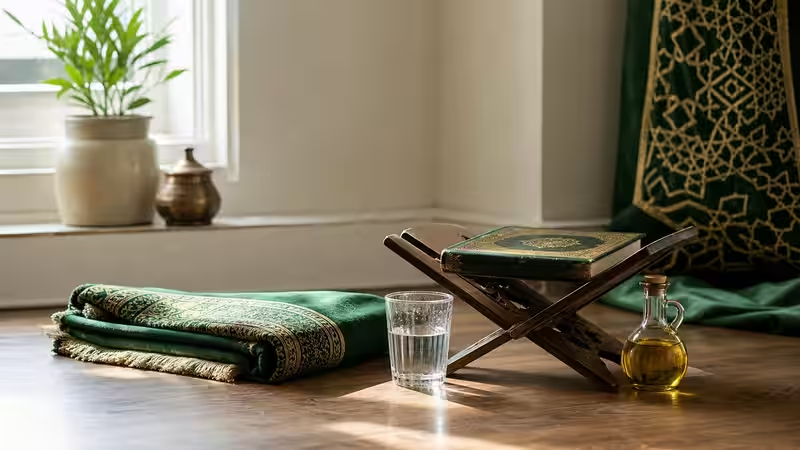
Before you seek any healer, know that the first reciter in your house should be you. The Prophet ﷺ recited over himself — and he left the method open, plain and free to every believer.
People travel across cities to sit before a reciter, and many of them could have been healed — or at least shielded — in their own rooms, with their own tongues, for the price of ten minutes a night. Self-ruqyah is not a lesser ruqyah; it is the ruqyah the Prophet ﷺ practised over himself, and it is the first door every believer should walk through before knocking on anyone else’s. This is the method, plainly, with its evidence.
Why you come first
‘Ā’ishah (may Allah be pleased with her) reported: “When the Messenger of Allah felt unwell, he would recite over himself Sūrat al-Ikhlāṣ and the Mu‘awwidhatayn, then blow (into his hands) and wipe (over his body). When his pain intensified, I would recite over him and wipe with his own hand, seeking its barakah” (al-Bukhārī and Muslim). Read that again: the Prophet of Allah, the one to whom Jibrīl brought revelation, treated himself with recitation before anyone touched him. If the best of creation did not consider self-ruqyah beneath him, no believer may consider it beneath himself.
There is a second reason. A healer sees you for an hour; you are with yourself every hour. The shield that is worn daily beats the shield that is borrowed monthly. Consistency, not intensity, is the engine of this sunnah.
Preparation: small, sincere, sufficient
- Wuḍū’. Purity is not a condition of du‘ā but it is the clothing of worship, and the reciter in wuḍū’ stands differently.
- A clean, quiet place. A corner of your room, your prayer mat, the car before you start the engine — anywhere the tongue can work without the heart apologising.
- Intention. You are not performing a technique; you are asking Allah. The words are the asking.
- Cover and calm. No audience is needed. Self-ruqyah is private by nature and loses nothing in privacy.
What to recite, and how
The following is drawn entirely from the Qur’an and the authentic Sunnah. There is no secret sequence and no purchased formula; anyone who sells you a “special arrangement” is selling what was never for sale.
- Sūrat al-Fātiḥah. The Companions used it as ruqyah and the Prophet ﷺ approved. Recite it slowly, seven times if you wish — the number seven appears in the narration of the chief stung by the scorpion, though the virtue lies in the recitation, not the arithmetic.
- Āyat al-Kursī (al-Baqarah 2:255). The verse of protection; whoever recites it at night, a guardian from Allah remains with him (al-Bukhārī).
- The last two verses of al-Baqarah (2:285–286). “Whoever recites them at night, they suffice him” (al-Bukhārī and Muslim).
- Al-Ikhlāṣ, al-Falaq and an-Nās, three times each. The Prophet’s ﷺ own nightly practice: recite, blow into the cupped hands, and wipe over whatever the hands reach of the body, beginning with the head and face (al-Bukhārī and Muslim).
- The ruqyah of Jibrīl. Bismillāhi arqīka, min kulli shay’in yu’dhīka, min sharri kulli nafsin aw ‘aynin ḥāsidin, Allāhu yashfīka, bismillāhi arqīka — in the name of Allah I perform ruqyah over you, from everything that harms you, from the evil of every soul or envious eye; may Allah cure you (Muslim).
- The du‘ā of the sick. Allāhumma Rabban-nāsi, adhibil-ba’sa washfi, antash-Shāfī, lā shifā’a illā shifā’uka, shifā’an lā yughādiru saqaman (al-Bukhārī and Muslim); and As’alullāhal-‘Aẓīma Rabbal-‘arshil-‘aẓīmi an yashfiyaka, seven times for the one in pain (Abū Dāwūd, at-Tirmidhī).
Blowing and wiping: the technique of the Sunnah
After the quls, bring your hands close to your mouth, recite into them, and blow with a light breath — a breath with only the faintest moisture, as the narrations describe, not spittle. Then wipe: the head and face first, then the chest, then whatever the hands reach of the body. Where the pain sits — a shoulder, a knee, a stomach — place the hand there and recite the du‘ā of the sick over it, as the Prophet ﷺ taught: place your hand on the pain, say Bismillāh three times, then A‘ūdhu bi‘izzatillāhi wa qudratihi min sharri mā ajidu wa uḥādhiru seven times (Muslim). This is the whole of the craft. Everything else is commentary.
Water and oil: carriers of the du‘ā
Recite the same verses over a glass or bottle of water and drink from it through the day; recite over olive oil or black-seed oil and anoint the place of pain, or the scalp and limbs, as generations of the Salaf have done. The belief that makes this lawful is precise: the barakah is in the recitation and in the One who answers it; the water and the oil are honoured carriers, never charms. Do not bottle them for sale, do not keep them as relics, and do not imagine that the liquid remembers anything — it is Allah who remembers, and He forgets nothing.
A nightly routine you can start tonight
- Make wuḍū’ and sit on your mat after ‘Ishā’.
- Recite al-Fātiḥah, yat al-Kursī and the last two verses of al-Baqarah.
- Recite the three quls three times; blow into the hands; wipe head, face and body.
- Place your hand on any place of pain and recite the du‘ā of the sick over it.
- Recite over your water for tomorrow and your oil for the week.
- Close with ṣalawāt upon the Prophet ﷺ and sleep on Āyat al-Kursī.
Ten minutes. Every night. No fee, no appointment, no intermediary between you and your Lord.
The posture of the heart while you recite
The words of ruqyah are fixed, but their weight is not — it is carried by the heart that says them. Three postures turn a recitation into a supplication. The first is presence: say the words slowly enough that you know what you are saying; a du‘ā rushed past the understanding is a letter delivered unopened. The second is poverty: begin certain that you bring nothing — no technique, no merit, no power — and that the only reason anything happens is that Allah answers whom He wills. The third is persistence without demand: recite tonight and tomorrow night and the night after, and if the relief comes slowly, let the slowness be part of the worship, for the believer is rewarded for the asking as much as for the receiving. The Salaf said the du‘ā is never wasted: it is answered, or it is stored, or it turns away a harm you will never know about.
Seven mistakes that empty self-ruqyah of its power
- Reciting only in crisis. The shield is built in health; the believer who begins his adhkar at the onset of pain has started digging his well on the day of thirst.
- Invented formulas. Anything that is neither Qur’an, nor authentic sunnah, nor a sound du‘ā of the Salaf, is an addition — and additions in worship are refused at the door.
- Counting instead of meaning. The numbers in the Sunnah are a mercy of order, not a magic of arithmetic; three quls said with the heart outweigh thirty said at it.
- Secrecy and theatre. Self-ruqyah needs no audience and no dramatics; if your practice requires witnesses, it has left worship and entered performance.
- Abandoning the clinic. The reciter who stops his medicine has not strengthened his ruqyah; he has contradicted the Prophet ﷺ who ordered treatment.
- Despair after a quiet week. Nothing felt? The fortress stood anyway; harms turned away leave no footprints to thank.
- Pride in the practice. The moment the reciter feels superior to the neighbour who does not recite, his shield has a hole in it shaped like his own heart.
What self-ruqyah changes in the one who recites
There is a fruit of this practice that has nothing to do with the complaint you brought to it. The man who recites over himself every night stops being a patient of circumstance and becomes a servant with a door of his own; the fear of the unseen shrinks to its true size, because the tongue that speaks to Allah daily cannot stay afraid of what Allah made. Wives notice it first: a husband who carries his own shield stops carrying his anxieties into the room. Children learn it second: a child who watches a parent recite over his own pain learns that healing begins on the knees before it begins in the queue. And the reciter himself learns the lesson every healer must eventually swallow — that he was never the healer, only the one who asked; which is the healthiest belief a human being can hold about his own hands.
When to seek help — and from whom
Self-ruqyah is the first door, not the only one. Seek a sincere, known reciter — and a physician — where harm persists for months despite consistency and treatment; where sleep, appetite or the mind are collapsing; where the body shows signs medicine must see. And test any reciter by the marks of honesty: no secrets, no symbols, no names demanded, no promises of dates, no prices scaled to your fear. A true reciter will send you back to your adhkar and your doctor as often as he sends you home.
Begin tonight. The room is yours, the words are open, and the Healer is nearer than the lamp you switch off to sleep.