Published by Shekie Mutumba · Editorial & corrections policy · Health information disclaimer
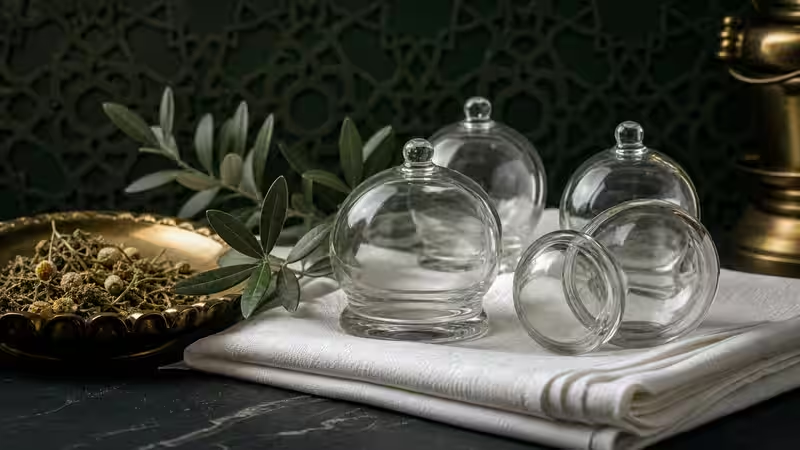
Hijama is a sunnah with cups in its hands: a simple, physical therapy the Prophet ﷺ underwent, recommended and paid for. It is not magic, and it is not a licence to abandon the doctor.
Of all the remedies in the Prophetic tradition, none is so physical, so visible, and so misunderstood as hijama. It involves no recitation and no herb; it involves a cup, a blade, and a few minutes of a person’s patience. Yet it carries the explicit praise of the Messenger of Allah ﷺ, and it has been practised by Muslim physicians for fourteen centuries. This article explains what it is, what the evidence for it is, what the evidence does not say, and how to receive it safely.
What hijama actually is
Hijama (حجامة), from ḥajm meaning volume or size, is cupping therapy. A cup is placed on the skin and suction is created — traditionally by flame, today by a hand pump — drawing the skin upward. In wet cupping (al-ḥijāmah ar-raṭbah), after a few minutes of suction the cup is removed, tiny superficial incisions are made in the raised skin, and the cup is replaced to draw out a small quantity of blood. In dry cupping no incision is made at all. The therapy the hadith speak of, and the therapy I offer, is the wet form, performed with sterile single-use blades and cups.
The evidence from the Sunnah
The hadith are explicit and famous. The Prophet ﷺ said: “If there were any cure in your treatments, it would be in the incision of the cupping vessel, or a drink of honey, or a branding with fire — and I do not like to be branded” (al-Bukhārī and Muslim). In another narration: “The best of remedies you treat with is cupping” (al-Bukhārī and Muslim), and in Muslim’s wording: “If anything in your medicines is good, it is in the cut of the cupper.”
He also named a day: “Whoever cups on the seventeenth, nineteenth or twenty-first, it is a cure for every disease” — reported by Abū Dāwūd and at-Tirmidhī. The scholars differ on the strength of this wording and on whether odd days of the lunar month carry a medical or a merely recommended character; the honest position is to say the recommendation of cupping itself is established beyond doubt, while the specific days are reported in narrations the muhaddithūn grade differently, so one may observe them out of love for the Sunnah without treating them as a medical law.
The Prophet ﷺ was cupped — and paid the cupper
This is not a remedy he merely mentioned; it is a remedy he underwent. Ibn ‘Abbās reported that the Prophet ﷺ was cupped while he was in iḥrām (al-Bukhārī), and was cupped on the top of his head for a contusion he suffered (al-Bukhārī and Muslim), and Anas reported that he was cupped on the two veins of the neck and between the shoulder blades (Abū Dāwūd, at-Tirmidhī). And when he was cupped, he paid the cupper his fee (al-Bukhārī). Three lessons sit inside these narrations: the therapy is physical and located on the body; it is lawful while in the sacred state of pilgrimage; and the labour of the cupper deserves payment — hijama has never been a charity-only art, and a trained practitioner earning his livelihood from it stands in the Prophet’s ﷺ own practice.
Why people seek it
Patients come for heaviness in the head and neck, stiffness across the shoulders, long-standing fatigue, migraine, and a general sense of congestion. The traditional physicians of Islam — Ibn Sīnā among them — placed cupping within a whole system of humours and evacuation, and the folk wisdom of the Muslim world has kept it alive in every generation. Many who receive it report lightness, eased tension and better sleep in the following days.
What the modern evidence honestly shows
Here I must speak plainly, because sincerity forbids me to dress a weak argument in strong clothes. Clinical research on wet cupping exists but is modest: small trials, often without proper blinding, reporting signals of benefit for neck and shoulder pain, migraine and some musculoskeletal complaints, alongside the well-known placebo and relaxation effects of any hands-on therapy. There is no high-quality evidence that hijama cures disease of the organs, purifies “dirty blood” in a laboratory sense, or treats infection, cancer or diabetes. The blood drawn is largely capillary and interstitial fluid mixed with blood; calling it “toxins” is a modern slogan, not a finding.
My position, therefore, is the position of the hadith itself: cupping is among the best of your remedies — a genuine, beloved sunnah with real therapeutic value for tension and pain — and it is not a substitute for diagnosis. I will never tell you that your scan is unnecessary. I will tell you that the cup and the clinic are not enemies.
Safety first: the rules I will not bend
A therapy that draws blood is a therapy that can harm if done carelessly, and the fiqh of preserving life makes safety a religious duty, not a preference.
- Sterile, single-use everything. Every blade, every cup that touches broken skin, every glove is used once and discarded. Reuse is how hepatitis and HIV travel; no fee in the world is worth that door.
- Skin prepared and site chosen. The area is cleaned, never cupped over broken skin, moles, varicose veins, or a fresh scar.
- Shallow incisions only. Superficial scratches in the raised skin — never deep cuts, never over major vessels, never on the face.
- Time limited. Suction is held only for minutes; blisters and bruising beyond the expected marks mean the technique was wrong.
- Modesty and mahram rules kept. A woman is cupped by a woman wherever possible; awrah is uncovered only to the extent the therapy requires and no further.
Who should not be cupped, or should be cupped only with a doctor’s word
Hijama is not for everyone. It should be avoided or deferred in: pregnancy (particularly the abdomen and lower back, and generally the first trimester); anaemia or known low haemoglobin; bleeding disorders and anyone on anticoagulants such as warfarin; the very young and the frail elderly; patients with severe heart disease, uncontrolled blood pressure, or recent surgery; anyone with active skin disease at the intended site; and people who are fasting in a weakened state or who have not eaten. If any of these describe you, bring your doctor’s opinion first — I will happily postpone a session for a blood test.
How a session with me goes
We begin with questions: your history, your medicines, your last blood count if you know it. You rest, we make du‘ā, and the cups are placed on the chosen points — commonly the upper back between the shoulder blades, the nape, and the shoulders — for a few minutes. The cups come off, the skin is lightly incised, and the cups return briefly to draw a small quantity of blood, typically no more than a few tablespoons in total. The wounds are cleaned and dressed, you drink water and something sweet, and you rest before you travel. Most people feel light-headed for an hour; that is normal. Heavy dizziness, fever or a weeping wound is not — and I ask to be told at once.
After the cups: aftercare and what to expect
The session is half the therapy; the day after is the other half. Keep the dressed sites dry for the first twelve to twenty-four hours, and do not swim, train hard, or expose them to dust and sun in that window. Drink water generously and eat something nourishing — the body has given a little blood and deserves a little kindness in return. Round, dark marks will remain for days to a fortnight; they are the signature of the suction, not of injury, and they fade. Expect tenderness at the sites and a wave of sleepiness in the evening; both are ordinary. What is not ordinary is a wound that weeps after two days, a spreading redness, a fever, or dizziness that does not lift with food and rest — and any of these means you call me or your doctor the same day, without embarrassment. I would rather hear from you twenty times for nothing than once too late.
The fiqh of paying for it
Because the Prophet ﷺ paid the cupper, the jurists hold the cupper’s wage to be lawful. What is not lawful is deception: charging for promises the therapy cannot keep, or scaling the price to a patient’s fear. My fee is fixed and stated before we begin, and no one is ever refused a session for poverty where I can afford the cups.
Cup and clinic, not cup or clinic
Hijama is a sunnah I love because the Prophet ﷺ loved it: physical, humble, honest work done with clean hands and a clean intention. Receive it with reverence for the Sunnah and respect for your body — sterile blades, a trained hand, a doctor’s word where your history demands one, and a heart that knows the cup is a means while the Shāfī, the Healer, is Allah alone.
Wa mā tawfīqī illā billāh — and my success is only with Allah.