Published by Shekie Mutumba · Editorial & corrections policy · Health information disclaimer
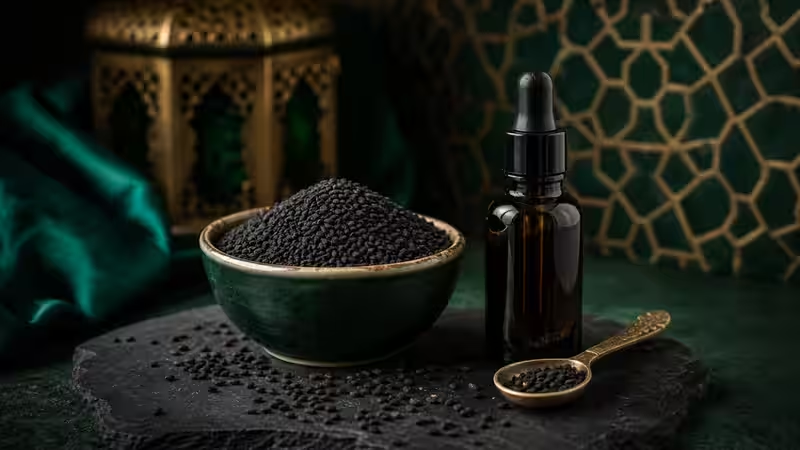
“In the black seed there is healing for every disease except death.” A sentence from the most truthful of creation, about a seed that costs less than a loaf of bread. Here is how to honour it without distorting it.
In the markets of Kampala, Cairo and Kano it is sold by the tin: small, matte-black, faintly peppery when crushed between the fingers. The scholars call it ḥabbat al-barakah, the seed of blessing; the botanists call it nigella sativa; the hadith call it healing. Few sunnah foods are so cheap, so available, and so surrounded by both neglect and exaggeration. This article gives the seed what it deserves: its evidence, its traditional use, its honest science, and its cautions.
The evidence
Abū Hurayrah reported the Messenger of Allah ﷺ saying: “In the black seed there is healing for every disease except death” (al-Bukhārī and Muslim). In Muslim’s narration through Khālid ibn Sa‘d: a companion asked Ibn Abī ‘Atīq what to do for a sick woman, and he answered: “Take the black seed, five or seven of them, grind them fine, and drop them into her nostrils with a few drops of oil on this side and this side — for ‘Ā’ishah told me that she heard the Prophet ﷺ say: this black seed is a cure for every disease except the sam (death).” And in another wording it is named ḥabbat al-barakah — the seed of blessing (al-Bukhārī).
Three things stand in these texts. The seed is blessed by the Prophet’s ﷺ own naming. The method of the Companions was physical and practical — ground, mixed, administered — not ceremonial. And the exception in the hadith, except death, is itself a lesson: every remedy in this religion stops at the door Allah reserved for Himself.
How the Muslim world has taken it
The tradition carries several forms, each with its households.
- The whole or ground seed with honey. The commonest way: half a teaspoon of seed, crushed fresh, stirred into a spoon of honey, taken in the morning. Crushing matters — the seed’s oils are sealed inside until it is broken.
- The cold-pressed oil. A teaspoon of dark, unrefined nigella oil, alone or over food. Cold-pressed means the oil was drawn without heat, keeping what heat destroys; the good oil bites the back of the throat slightly.
- The seed in bread and stew. From Ethiopian ḥabasha bread to Egyptian dukkah, the seed has ridden inside ordinary food for centuries — the quietest and most sustainable way of all.
- The oil anointed in ruqyah. Recited over and massaged into the place of pain, or the scalp and chest, as the Salaf anointed with recited oils.
What the research honestly shows
Sincerity requires me to say plainly what the laboratories have and have not found. Nigella sativa and its active compound thymoquinone have been studied widely: trials and meta-analyses report modest, encouraging signals for blood pressure, fasting blood sugar and lipid profiles, for inflammation markers, and for asthma and allergic symptoms; laboratory work shows antimicrobial and antioxidant activity. Most human trials are small and short. Nothing yet rises to the height of the hadith’s wording — and a believer does not need it to, because the hadith is not a clinical abstract; it is a direction of blessing from the one who does not speak from desire.
So the honest position is this: take the seed as sunnah and as food, expect from it what a blessed food gives — steadiness, not miracles — and never let it displace a prescribed medicine. The same Prophet ﷺ who praised the seed commanded treatment; the seed is a companion of the pharmacy, not its rival.
Cautions the sellers omit
- Pregnancy. Concentrated nigella oil has a traditional reputation for stimulating the womb; culinary amounts in food are one matter, medicinal doses another. A pregnant woman asks her midwife or doctor before taking the oil daily.
- Blood sugar and blood pressure. Because the seed may lower both, the diabetic and the hypertensive who add it in medicinal amounts should tell their doctor — doses of their medicines may need review, and silent hypoglycaemia is not a blessing.
- Surgery. As with anything that touches sugar and clotting, stop medicinal doses about two weeks before a planned operation.
- Allergy and the stomach. A minority react to nigella with rash or stomach upset; begin with a small amount and watch your body, which is also a trust from Allah.
- Children. Food amounts are fine; medicinal oil doses belong to a clinician’s judgement.
Buying, storing, and not being cheated
Three market rules. Buy the seed whole and crush it at home — pre-ground seed loses its oils within days and much of what is sold as “fresh ground” is old. Buy the oil dark, cold-pressed, in a dark glass bottle, and keep it cool and closed; light and heat turn blessing into rancidity. And beware the price of miracles: the oil sold at ten times the market rate in a “blessed” bottle is the same oil, and the barakah was never in the markup.
The seed in the practice of the Salaf and the physicians of Islam
The black seed did not wait for modern capsules to enter medicine; it walked in with the Companions. The narration of Khālid ibn Sa‘d shows them grinding it and administering it with oil for a complaint of the head — a physical, unsentimental use, exactly as one uses a medicine. The physicians of the classical tradition took it further: Ibn Sīnā mentions it in his canon for the chest and the head, and the folk medicine of every Muslim land kept a household use — the seed in honey for the cough, the oil massaged into the temples for the heaviness, the crushed seed in the nostrils for the blocked head as the Companion’s method described. None of this elevates the seed above its station; it shows a ummah that heard healing for every disease except death and answered with a spoon, a grinder and a steady hand.
Three simple ways to take it this week
- The morning spoon. Crush half a teaspoon of seed fresh — a mortar, a spice grinder, even two spoons and patience — stir it into a teaspoon of honey, and take it before breakfast. Fresh crushing is the whole secret; the seed keeps its oils sealed until broken, and pre-ground seed from a tin is largely spent.
- The evening anointing. Warm — never fry — a teaspoon of cold-pressed nigella or olive oil, recite over it the quls and the du‘ā of the sick, and massage it into the chest, the temples, or the place of pain before sleep. This is the Salaf’s recited oil: a carrier of du‘ā, applied with a hand that knows the Healer is not in the bottle.
- The bread and the stew. Sprinkle the seed over dough before baking, or into a stew in its last minutes, as the kitchens of the Muslim world have done for centuries. This is the quietest method and the most sustainable: the blessing enters the family through the ordinary door of dinner, and no one has to remember a dose.
Whichever you choose, choose it for a season rather than a week. Blessed foods work like blessed habits: slowly, cumulatively, and without announcement. Judge the seed not by a sudden miracle but by a steadier month — and keep your doctor’s appointments inside that month, because the seed was sent to accompany your treatment, never to replace it.
What I keep in the shop, and how to choose yours
Because people ask, here is plainly what I stock and why: whole nigella seed in sealed tins, so that each household crushes fresh and keeps the oils alive; cold-pressed nigella oil in dark glass, pressed without heat and bottled without additives — the label should name one ingredient and nothing else; and raw honey for the morning spoon, since the seed and the honey were praised by the same tongue and travel well together. I do not stock “blessed” blends of seven oils at seven prices, and I never will: the sunnah is a seed and a spoon, not a marketing funnel. If you buy elsewhere, buy by the same three rules — whole seed, dark cold-pressed oil, honest label — and spend the saving on the poor, which is also medicine.
A seed, not a shrine
The danger around every blessed food is that it slides from sunnah into shrine: measured by the drop, argued over by the forum, trusted in place of the Physician who blessed it. The Salaf took the seed the way they took everything — with a steady hand and a settled heart: half a teaspoon in the morning honey, a massage of recited oil at night, gratitude on the tongue, and the clinic kept open beside the kitchen.
That is the seed of blessing: cheap, near, honest — healing by the permission of the One who named it, and a daily reminder that Allah placed medicine in the market as well as in the mosque.
Take it, then, as the Salaf took it: a seed in the honey, an oil on the skin, a blessing on the tongue — and the physician’s door left open beside the kitchen’s. The Prophet ﷺ named it healing; your part is only to use it with a steady hand and a settled heart, and to return the thanks to the One who put barakah in so small a thing.
Allāhumma bārik lanā fīmā razaqtanā — O Allah, bless us in what You have provided us.