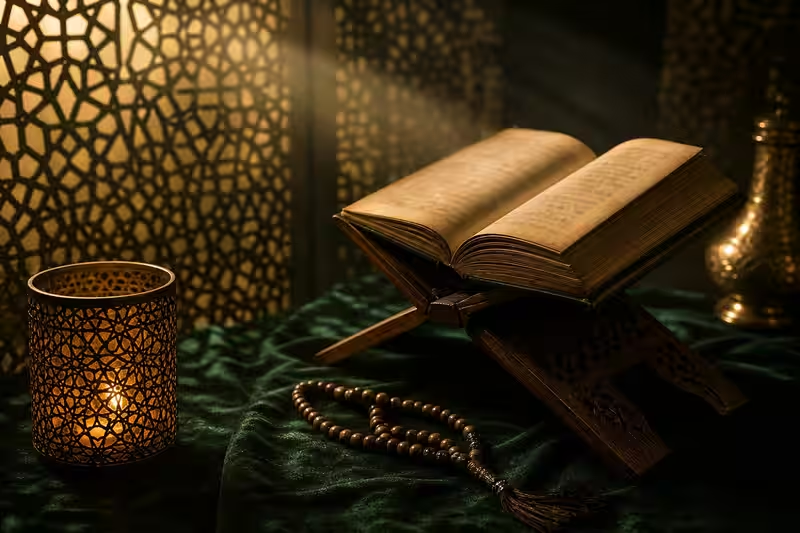
A 140-page practical guide to authentic ruqyah, in English with the Arabic text of every verse and du'a — written for ordinary Muslims who want to protect and treat themselves and their families without depending on anyone.
It covers what ruqyah is and what it is not; the three conditions the scholars give for a ruqyah to be permissible; the verses used, with Arabic, transliteration and translation; how to perform ruqyah on yourself, your spouse and your children; how to prepare ruqyah water and oil; the daily adhkar that form real protection; and the tawhid that all of it rests on.
A substantial section is devoted to what most books avoid: how to recognise a fraudulent raqi, the difference between genuine symptoms and the vague list charlatans use, why amulets and “protection” strings are shirk, and when your problem is medical rather than spiritual — including depression, anxiety, epilepsy and sleep disorders.
It is a practical manual, not a substitute for a scholar, and it says so plainly. Written for a general reader, with references throughout and a glossary.
This listing is one printed copy.
Before requesting an order, read ordering, delivery and returns and our privacy policy.
Delivery availability, charges and estimated timing are confirmed by the team before your order is accepted.
Packaging
The team will confirm suitable packaging and delivery arrangements for your order.
Tracking
Your order-request reference is displayed after submission. The team will confirm dispatch and any available tracking details with you.
This handbook was written because of what we see every week in our messages: people who are frightened, exhausted, sometimes seriously ill, and convinced by a stranger that they are bewitched. Some have spent thousands of dollars. Some have been told their mothers poisoned them. Some have stopped taking medication for epilepsy or depression on the instruction of a man with a WhatsApp number. Almost none of them had ever been shown what authentic ruqyah actually is — which is free, simple, and something they could have been doing themselves the whole time.
What the book is
A 140-page practical manual, in English, with every verse and du'a given in Arabic script, transliteration and translation. It is written for a general reader — no prior study needed — and it is organised so that you can read it straight through once and then keep it as a reference you open to a specific chapter when you need it.
The approach throughout is the same: start with tawhid, stay with the evidence, be honest about what is established and what is not, and treat the reader as an adult who can handle a straight answer.
What is inside
Part one — foundations. What ruqyah is in the Qur'an and sunnah, and what it was in the practice of the sahabah. The verse in al-Isra, “We send down of the Qur'an that which is healing and mercy for the believers.” The hadith “there is no harm in ruqyah so long as it does not involve shirk.” The narration of al-Fatihah recited over a man stung by a scorpion. The distinction between a means (sabab) that Allah has honoured and a cause that has no basis — and why that distinction is the entire subject.
Part two — the three conditions. The classical test, chapter by chapter: that the ruqyah be with the words of Allah, His names and attributes, or authentic du'a; that it be in Arabic or a language whose meaning is understood; and that the cure be believed to come from Allah alone, not from the recitation, the reciter or the ritual. Each condition is explained with its evidence and with examples of what violates it.
Part three — the texts. Every verse and du'a used in authentic ruqyah, laid out for recitation: al-Fatihah; Ayat al-Kursi; the last two verses of al-Baqarah; the verses of sihr in al-A'raf, Yunus and Taha; the verses of healing; al-Kafirun; al-Ikhlas, al-Falaq and an-Nas; and the du'as of the Prophet ﷺ for protection and healing, including “Adhhib al-ba's Rabba'n-nas…”, “Bismillahi arqik…”, “As'alullaha'l-Adhim…”, and the du'a said seven times for pain. Arabic, transliteration, translation, and a note on when each is used.
Part four — doing it. Step-by-step self-ruqyah. Ruqyah for a spouse, for children, for a person who is asleep or unwell. How to place the hand on the site of pain and what to say. How to prepare ruqyah water and ruqyah oil, including the sidr method transmitted by the scholars and an honest note that it is a scholarly practice rather than a hadith. How to build a daily routine of morning and evening adhkar, which is where real protection lives.
Part five — 'ayn, sihr and waswas. What the Qur'an and sunnah actually say about the evil eye, magic and whispering. What the classical scholars said. The danger of the modern “symptom checklist”, which is vague enough to fit every human being alive and is the single most common tool of exploitation. How to make the du'a for protection, what to do if you genuinely suspect the evil eye, and why you should never accuse a specific person.
Part six — shirk and its doorway. Amulets (ta'wiz, hirz), “protection” strings and rings, writing verses to be dissolved and drunk, knots, burying objects, seeking help from jinn, asking the dead, horoscopes and “spiritual readings”. Why the Prophet ﷺ said that whoever wears an amulet has committed shirk, and how a frightened person is walked, step by step, from a Qur'anic verse on a string to something far worse.
Part seven — how to recognise a fraud. The largest and, we think, most useful chapter. The questions to ask before you accept treatment from anyone. The red flags: asking your mother's name, guaranteeing results, naming a specific relative as the one who did magic to you, escalating fees, insisting that only they can treat you, telling you to stop medication, selling oils and water at marked-up prices, refusing to explain what they recite, working in secret, isolating you from your family. What a genuine, knowledgeable person will and will not do.
Part eight — when it is medical. A plain, unsentimental chapter on the conditions most often misattributed to sihr and 'ayn: depression, anxiety and panic disorder, sleep paralysis, epilepsy, thyroid disease, iron and B12 deficiency, chronic fatigue, psychosis, trauma, and marital breakdown. What each can look like, why the overlap with “spiritual symptoms” is so complete, and how to get properly assessed. The principle throughout: the sunnah commands you to seek treatment, and delaying it is not piety.
Part nine — the household. Making the home a place where shaytan is not welcome: reciting al-Baqarah, removing images and objects of shirk, adhkar on entering and leaving, how to teach children their protection du'as, what to do about a house where things feel wrong, and how to handle a family member who has gone to a sahir.
Appendices. A one-page recitation order you can photocopy and keep in the Qur'an. A checklist of questions to ask a raqi. A glossary of Arabic terms. A list of references, so that everything in the book can be checked.
How to use it
Read parts one and two first — they take under an hour and they change how you read everything else. Then go to part four and start the practice: self-ruqyah before sleep, morning and evening adhkar, al-Fatihah and the mu'awwidhat over water. Keep the book where you will see it. If someone in your family is unwell or distressed, read part eight before you read part five, honestly.
Who it is for
Anyone. Specifically: parents who want to protect their children without fear; people who have been told they are bewitched and do not know what to believe; converts who have inherited a household full of amulets and no idea what is permitted; imams and community volunteers who are asked for ruqyah and want to do it correctly; and anyone who has paid a stranger for something they could have done themselves for free.
What it will not do
It will not diagnose you, and it will not tell you that you have sihr. It will not replace a scholar — where the book summarises a juristic question, it says so and points you to someone qualified. It contains no secret knowledge, because there is none: everything in it is from the Qur'an, the sunnah and the classical scholars, and it is deliberately free of the mystique that makes exploitation possible. If a chapter leaves you more frightened than before, we have written it wrong; the intention is the opposite.
Format and quality
Printed paperback, 140 pages, English text with Arabic in a clear readable script. Designed to lie flat, with wide margins for notes and a durable cover, because it is meant to be handled next to water and used daily rather than shelved. Verses are set in blocks so you can recite directly from the page without losing your place.
Using it with the rest of the practice
The handbook pairs with our ruqyah water preparation kit, which contains the sidr, bottle and card the book describes; with our sidr leaf powder for those who already have a vessel; and with a Ruqyah Shar'iyyah session if you would like to be taught the practice by a person rather than from a page. Most people need the book and nothing else.
Frequently asked questions
Is the Arabic included? Yes — every verse and du'a, with transliteration and translation.
Do I need to read Arabic? No. The transliteration and audio-free step-by-step instructions are written for someone who does not.
Is it a scholarly work? It is a practical manual with references, written for a general reader. It does not replace asking a qualified scholar about your specific situation.
Which madhhab? The book sticks to what is agreed and flags differences where they matter, rather than arguing positions.
Is it suitable for children? Part four and the appendices are useful for teaching children their adhkar with a parent.
Does it teach how to treat others? It teaches self-ruqyah and family ruqyah, and it is explicit that treating strangers is not something to take up lightly.
Will it frighten me? It is written to remove fear, not to create it. There are no case studies of possession and no descriptions designed to alarm.
A final word
The reason this book exists is a single sentence in Sahih Muslim: there is no harm in ruqyah so long as it does not involve shirk. That sentence gives you a permission and a boundary, and between them is everything a Muslim needs — free, portable, and dependent on no human being. Learn it, practise it, teach it to your children, and do not pay anyone for what Allah has already given you.
May Allah make the Qur'an the spring of your heart, a healing for your chest, and a light for your home. Amin.